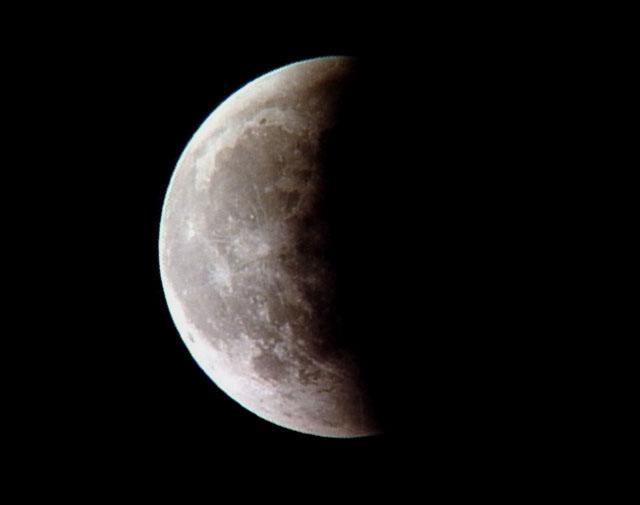
This image shows the partial phase of the eclipse, quite similar to the view with the naked eye, or in binoculars. This photo taken around 9:00pm PDT (Sept 26, 1996) shows the Earth's shadow covering the right portion of the moon as it was slowly moving left to right. The shadow took just over an hour to completely leave the moon.
You can easily see that the edge of the shadow is curved. This is a very important fact to our understanding of our own earth, as it tells us that the object that is causing the shadow is round. Yet, 500 years ago when Columbus sailed to America, the common belief was that the Earth was flat. Try it for yourself, by taking a tennis ball or basket ball outside, hold it up and see what type of shadow is cast on the gound. You can also try the same experiment, but use a book, or any other object you can find, and see how the shadows differ.
Photo taken on 35mm Ektachrome (P1600) film with a camera attached to my 6"
telescope from Burlingame. For those without a big telescope,
you can use a telephoto lens (or lens with a 2X converter to increase the range) mounted on a
tripod. Your exposure meter will help with the correct exposure, but make sure you bracket around the settings.
For VIDEO enthusiasts, you can easily record the eclipse with your video camera.
Setup the camera on a tripod for stability and zoom in to get a good frame. Don't over zoom, or the moon will move
too fast out of the field. You'll have to continually adjust the pointing of the video camera, since the moon will appear
to move because of the rotation of the earth. You'll have to play with the correct exposure settings on your camera,
and may have to adjust it at maximum eclipse. But by all means, have fun!
Photo Copyright ©1996 by Paul Mortfield